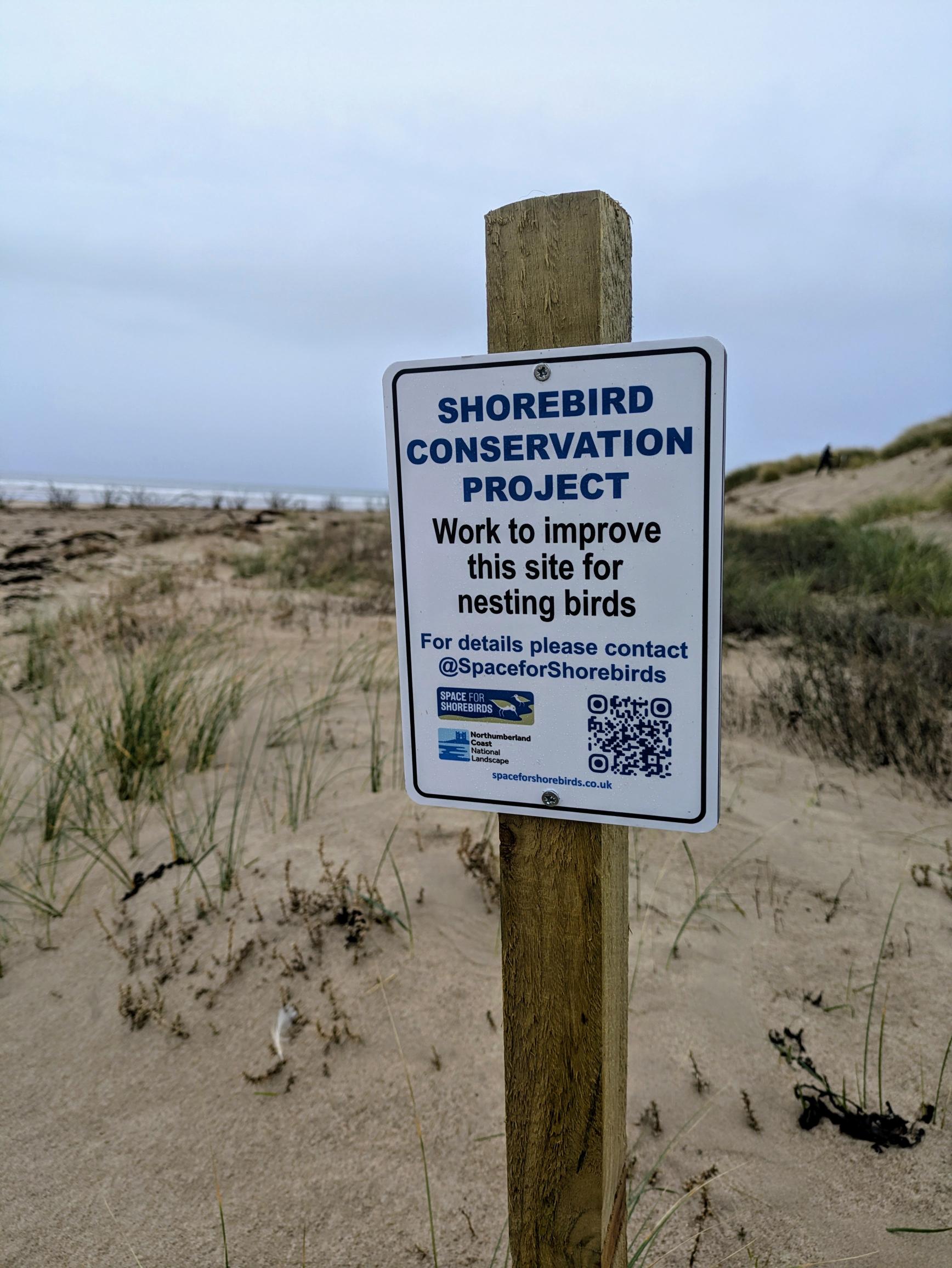

Brash to the Rescue at Buston Links!
Winter is still raging on along the coast, but this week, our attention has turned to spring, as our preparations for the upcoming nesting season began! Some of you may have spotted some unusual looking branches sticking out of the ground at Buston Links – no we aren’t trying to plant a woodland on the beach! There is method to the madness…
Very soon, ringed plovers will begin scouting out the habitat along the coast looking for a suitable place to nest. Rangers have already spotted a few birds which look like they might already be holding a nesting territory – the tell-tale ‘ooo-eep’ sound of an agitated ringed plover being heard as we walk past one of last year’s nesting sites.

A pair of ringed plover ‘on territory’ at Buston Links in 2023
We first started protecting ringed plover nests along the Northumberland coast in 2021, and each year since then Buston links has been one of our most important sites. Up to 3 pairs nest here, which doesn’t sound like many, but given how territorial these birds are it is a testament to just how good the habitat is that they have learned to share the space.
Buston has everything you need if you are a ringed plover looking for a good place to nest:
- Low disturbance from people and dogs
- Lots of cover amongst embryo dunes and debris for staying camouflaged
- Great feeding opportunities for young chicks
- (A great team of wildlife rangers and volunteers helping to keep you safe!)
However, all nesting sites have their challenges – predation and high tides being two of the biggest threats. Using nest cages can help to stop predators such as crows, rooks and foxes taking eggs – more information about this can be found on our blog post ‘Plovers, Camera, Action!’.

A ringed plover sitting on a nest protected by a cage at Buston Links
To try and combat the issue of high tides washing away precious nests, we are trialling a project to increase the height of the beach by burying branches along the high tide line. Over time, the theory is the brash will trap debris and sand, building up height and giving the birds more space to nest.
Last year, the Northumberland Coast National Landscape led a project to remove invasive sycamore trees from the dune grassland just behind the beach. Trees should not be growing in this habitat as they alter the growing conditions for delicate wildflowers (more about this can be found on our ‘How is a Sand Dune Formed’ blog post).
A hardy group of Northumberland Coast Conservation Team volunteers joined us to drag the felled sycamore branches onto the beach and bury them along the high tide line surrounding the best of the nesting habitat. This was very physical work, and we made some excellent progress even in some pretty tough wintery conditions.

The end result!
The hard work has already started to pay off, as the buried brash has survived the recent winter storms, and is already starting to trap washed up seaweed and other debris, with the sand blowing in the wind beginning to build up around the branches!

Sand beginning to build up around the brash
We’ll keep a close eye on how the site is progressing, and will return in early April to cut down the branches which are sticking up above the sand so they are not used as perching posts for crows and kestrels before the ringed plovers start nesting.
Before we know it, it will be time to start rolling out our fencing as eggs begin to be laid along the Northumberland coast! We can’t wait to see what this nesting season has in store for us, and hope that our hard work at Buston over the winter makes this site even more valuable for the birds.